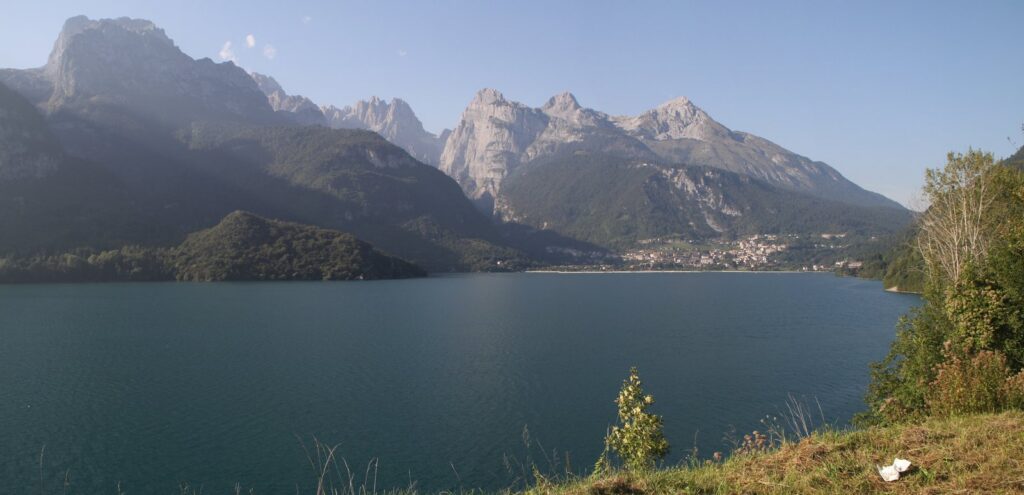
The Valsugana lakes are the defining feature of the upper valley. There are two of them, aligned along the valley floor and separated by a low moraine ridge and about five kilometres of road: Lake Caldonazzo to the north-east and Lake Levico to the south-west. Both are of glacial origin, fed by underground sources and minor tributaries, and form one of the few swimmable lake systems set squarely within the Italian Alps. Not far away, at higher elevation, there is a third, much smaller body of water — the little lake of Roncone (better known as the Vigolana tarn) — which rounds out the system.
Lake Caldonazzo
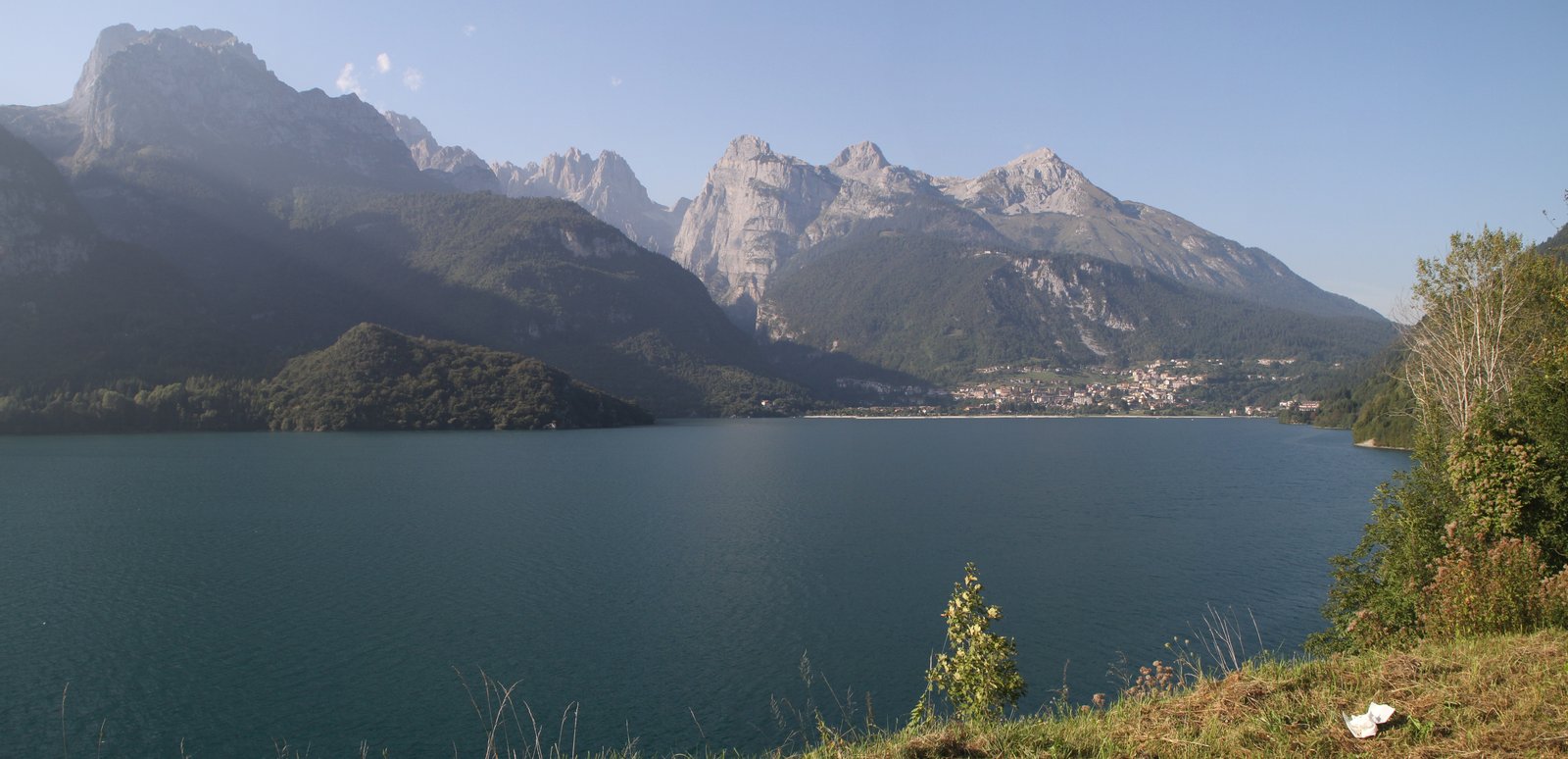
Lake Caldonazzo is the largest natural lake lying entirely within the province of Trento. It covers an area of around 5.4 square kilometres, with a maximum length of just over 5 kilometres and a depth that reaches 49 metres at its central point. It sits at 449 metres above sea level, fed by the Mandola stream and by several underwater springs, and gives rise to the river Brenta at its southern outflow.
Four municipalities sit on its shores: Caldonazzo to the south, Calceranica al Lago to the south-west, Pergine Valsugana to the north, and Tenna to the east. Each has developed its own tourist identity. Calceranica and Caldonazzo hold most of the lidos and the historic campsites; Pergine has the northern shore, less built up, with protected stretches of reedbed; Tenna gives access to the sheltered bay of the Lucchesi.
Swimming runs from late June to early September, with water temperatures climbing from around 19 degrees at the start of the season to 24-25 degrees in the last two thirds of July. Water quality is monitored by APPA Trento with regular sampling and has for years been classified as excellent at the main bathing points. The lake supports rowing (it is the base of the Caldonazzo rowing club, active at competitive level), sailing, windsurfing, stand-up paddleboarding and canoeing; it has also hosted stages of the Canoe Polo World Cup. The lakeside loop, suitable for walking and cycling, can be ridden in full, with stretches that are deeper in the woodland on the northern shore.
Lake Levico
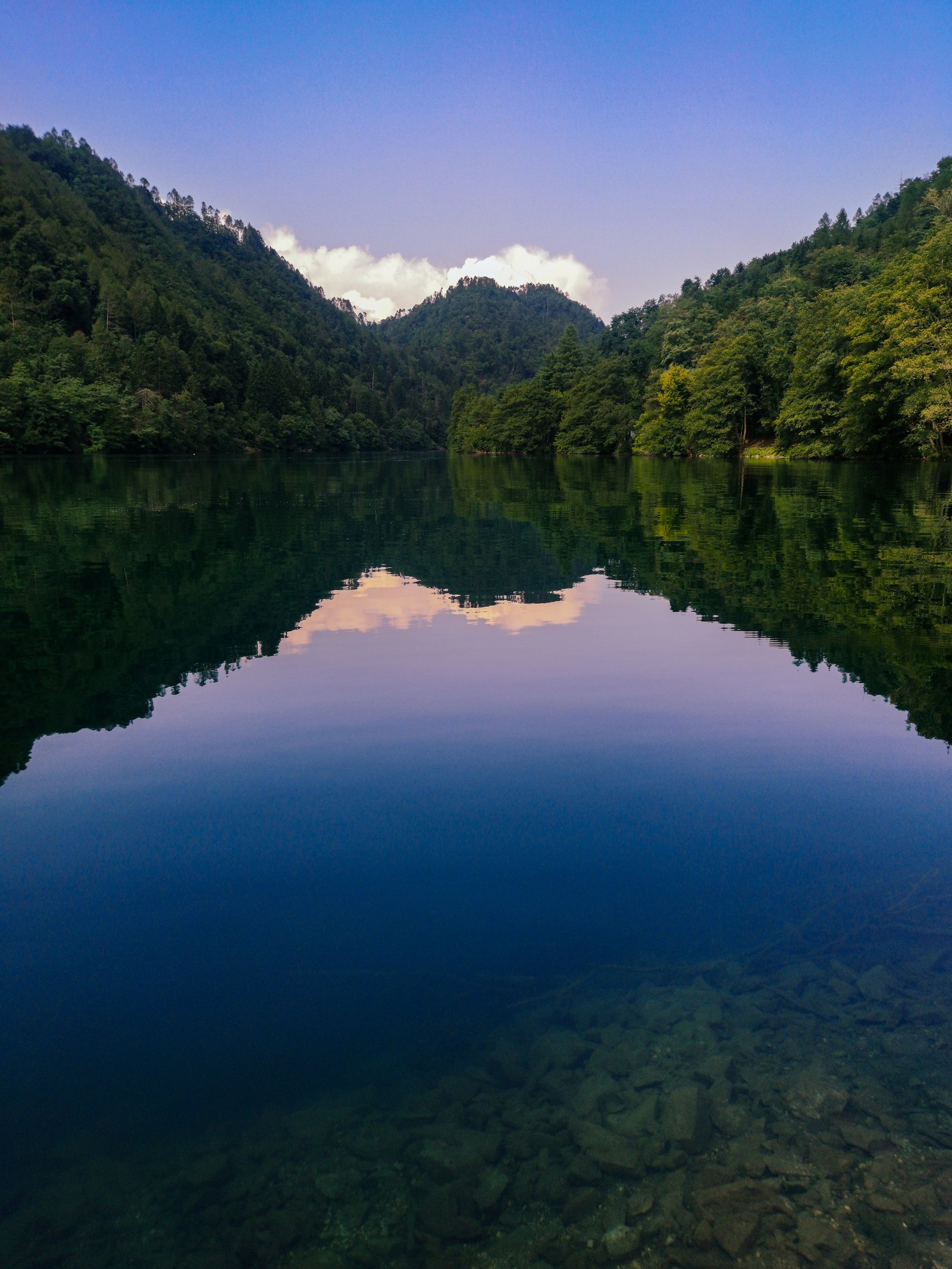
Lake Levico is more compact: roughly 1.1 square kilometres in area, just under 3 kilometres long, with a maximum depth of 38 metres. Its elevation is slightly lower than Caldonazzo’s, around 440 metres, and the water is unusually clear thanks to the relatively slow exchange and to the wooded catchment that limits sediment input. It is hemmed in on three sides by relief: Monte Tenna to the north, Monte Cimone to the east, and the slopes of Vigolana to the south-west, which give it the elongated shape and the gathered, almost enclosed feel that sets it apart.
The lake is jointly administered by the municipalities of Levico Terme and Tenna. The principal access point is the municipal beach of Levico, equipped with services and a grass lawn; a second public access is the Lucchesi beach on the Tenna side. The lakeside loop, of around 6 kilometres, is one of the most agreeable flat routes in the valley: it alternates white-gravel sections, wooden bridges, walkways at water level, and crossings of streams coming down from the woods. It is suitable for prams and for light running.
Swimming is quieter than at Caldonazzo: fewer lidos, fewer rentals, a more residential atmosphere. Sport fishing is practised by several local associations and is regulated by the Associazione Pescatori Alta Valsugana; species include trout, perch, tench, bleak and eel. Sailing and windsurfing are possible but little practised, partly because of a thermal current that picks up in the afternoon and which calls for a degree of care.
The Roncone tarn (Vigolana)
Smaller, higher and less frequented, the Roncone tarn sits on the Vigolana plateau, in a wooded bend reached on a short walk from the village of the same name. It is a small spring-fed body of water, generally not swimmable for reasons of temperature and regulation, but of considerable scenic value. It is reached in about forty minutes on foot from the car park at Vigolo Vattaro, along an up-and-down path suitable for all. It is a good destination for travellers seeking a more reserved alternative to the two large lakes.
Lidos, public access points, prices
On Lake Caldonazzo the active lidos are found mainly at Calceranica, Caldonazzo and Tenna; some offer day passes (typically between 5 and 8 euro per person), others work on a seasonal membership basis. They have grass lawns, sun loungers for hire, bars, children’s play areas, and in some cases an additional swimming pool. There are also free public access points, in particular along the northern shore, with open lawn but no services.
On Lake Levico the municipal beach is the main reference, with free entry and basic facilities. For current details on rates and opening times we refer the reader to the individual lidos’ websites and to the municipalities of Caldonazzo, Calceranica and Levico, which publish the full list of bathing points and the seasonal ordinances.
What to do on the Valsugana lakes beyond swimming
Electric boat hire. On Caldonazzo it is possible to rent small electric boats, SUPs, canoes and pedalos; hourly rates generally start from 12-15 euro for SUPs, 18-25 euro for two-person canoes, and 25-35 euro for electric boats. Navigation is permitted without a licence up to a certain output; above that, a boating licence is required.
Rowing. Caldonazzo is a recognised competitive base for Italian rowing: the Federal Rowing Centre hosts national and youth training camps. For visitors, the local club runs introductory summer courses, usually by the week, for adults and for children from the age of twelve.
Fishing. To fish in either lake you need a FIPSAS licence and a daily or weekly permit issued by the local associations. The most common species are lake trout, perch, tench, pike (in Caldonazzo), bleak and rudd.
Lakeside loop by bike. The full loop of Lake Caldonazzo, around 13 kilometres, is ridable in just under an hour at touring pace, flat except for a few rises between Tenna and Pergine. The loop of Lake Levico, around 6 kilometres, takes half an hour and includes some scenic walkway sections.
A note on Lake Caldonazzo as the source of the Brenta
The Brenta officially rises from Lake Caldonazzo: the outflow leaves the lake at the so-called Mandracchio, takes the name of river Brenta shortly afterwards, and runs through the whole of Valsugana down to Bassano del Grappa. It is a geographical fact often overlooked by visitors, but it has practical consequences: the level of the lake is regulated for hydraulic purposes, and in rainy weeks it is normal to see fluctuations of several centimetres.
- Levico Terme — the spa town and its historic park.
- The Valsugana cycle path — runs alongside both lakes.
- Valsugana holidays — when to go and where to stay.
- Back to the home page