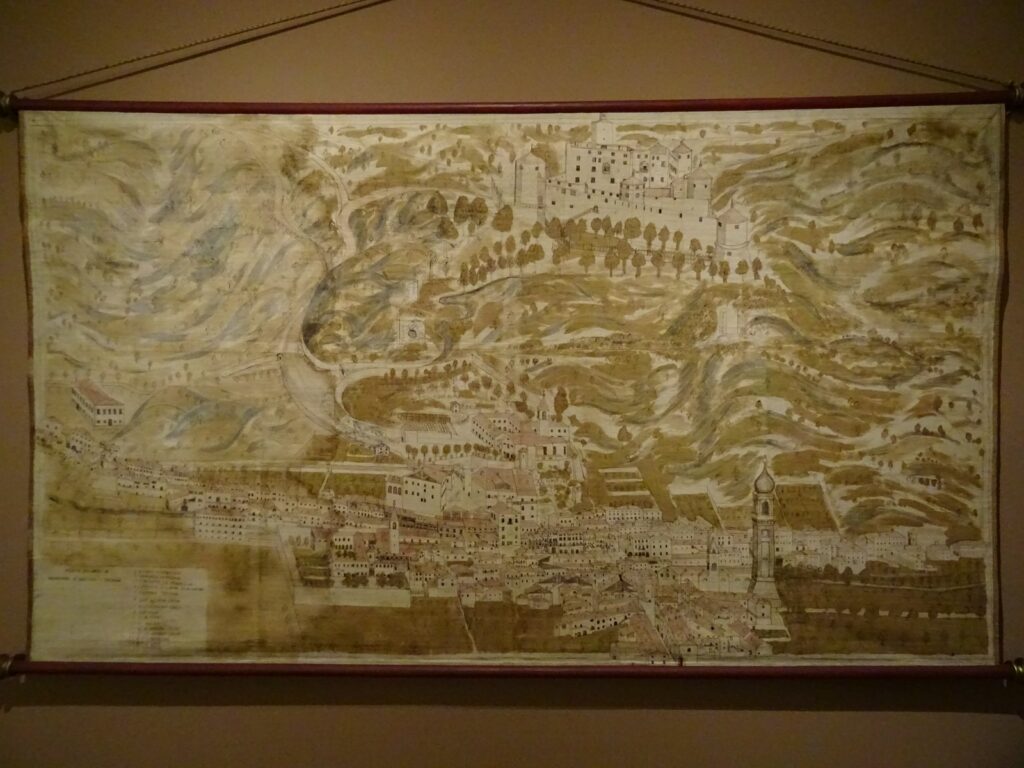
The history of Valsugana is the history of a frontier valley. For close to a millennium, from the early Middle Ages until 1918, it formed the southern edge of the territory of Trento and then of the Habsburg lands, separated from the Venetian plain by tight mountain ranges and by an ancient Roman road that ran from Trento to Aquileia. This position on the threshold, between Central Europe and the Venetian world, has left deep marks on how the territory is organised, on the castles that dot it, on the twentieth-century military architecture, and on the memory of its communities.
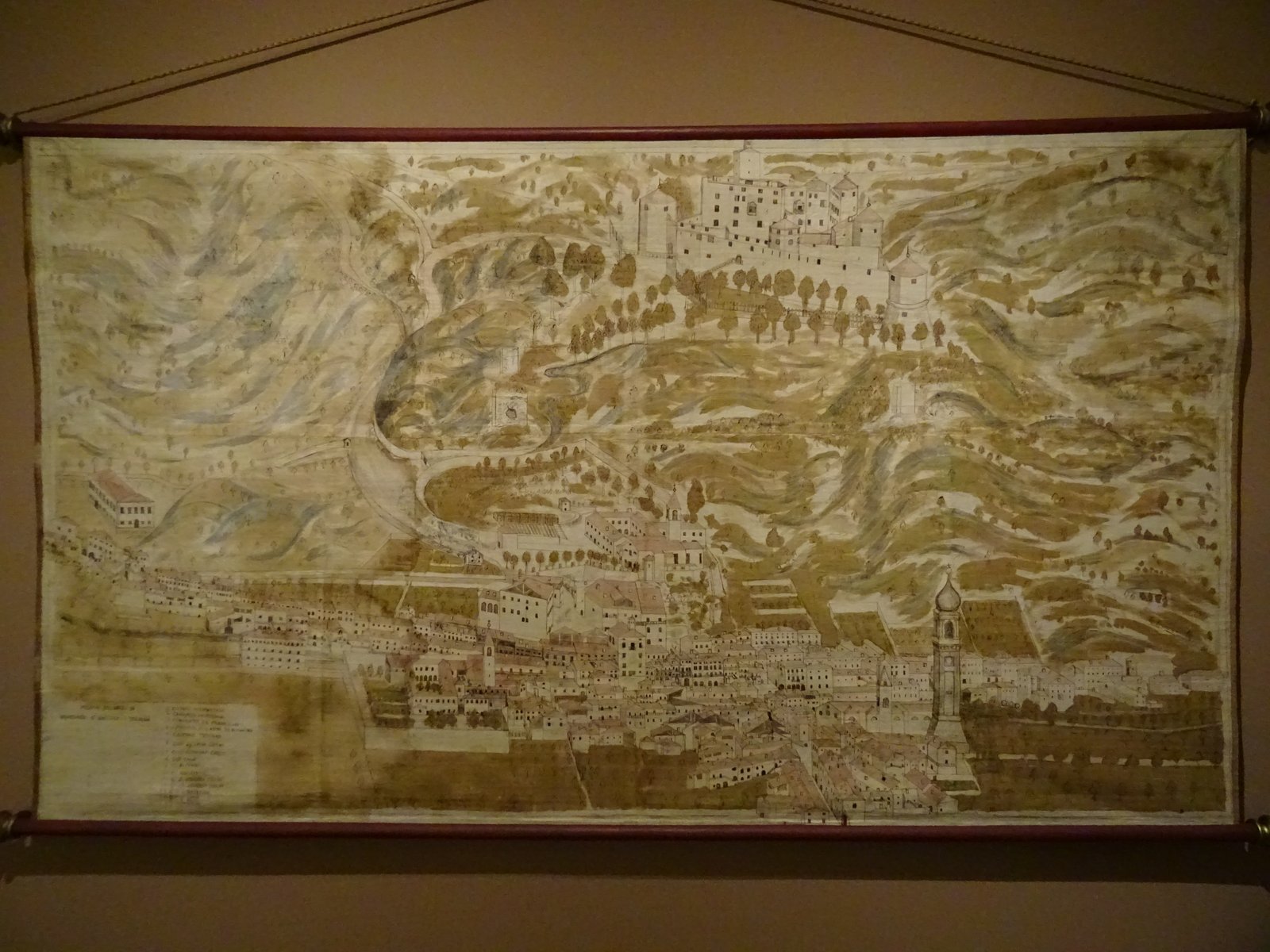
The origins of the history of Valsugana
Valsugana was already crossed in Roman times as a link between Tridentum (Trento) and the territory of Feltria. Lowland settlements are attested at Pergine, Caldonazzo and Borgo. With the arrival of the Lombards the valley falls within the orbit of the duchy of Trento, and during the early Middle Ages it fragments into small rural settlements tied to feudal families.
Between the eleventh and twelfth centuries the network of castles that would shape the valley’s identity for centuries takes form: Castel Pergine above the town of the same name, Castel Telvana at Borgo Valsugana, Castel Ivano in a commanding position over the lower valley. They serve as control points for traffic and toll collection rather than as permanent residences. Formal authority belongs to the prince-bishopric of Trento, but in practice power is distributed among the local families.
The Venetian frontier
Between the late fifteenth and the early sixteenth century Valsugana becomes the hot edge of the border between the principality of Trento and the Republic of Venice. The War of the League of Cambrai (1508-1516) draws the valley in directly: the lower valley is temporarily occupied by Venetian troops, then retaken by imperial forces. A balance settles that lasts through to the eighteenth century, with the lower valley culturally closer to the Veneto and the upper integrated into the Trentino system.
Through the central centuries of the early modern period the valley sustains a mixed economy: valley-floor farming, transhumance pasture on the Lagorai and the Vigolana, mining in the Tesino, small textile workshops along the watercourses. Trade on the Brenta, navigable in sections, opens an exchange route with the Venetian plain. Seventeenth-century documents describe a relatively poor but stable valley, balanced between the village communities (the “regole”) and the residual feudal powers.
The Habsburg era and the move to modernity
With the secularisation of the prince-bishopric in 1803 and the subsequent passage to the Austrian Empire, Valsugana enters a phase of modernisation. In 1896 the Valsugana railway is inaugurated, built for strategic reasons as much as commercial: it connects Trento to Tezze, with the project of an extension towards the Veneto, then still politically separated.
The Habsburg phase also sees the birth of the spa station of Levico. The iron- and arsenic-bearing waters of Vetriolo, already known in the medieval period, are industrialised at the end of the nineteenth century by the Sigl family, who in 1880 build the Grand Hotel Imperiale and lay out the Habsburg park. Levico becomes in the decades that follow one of the favoured cure stations of the Central European aristocracy: the emperor Franz Joseph, members of the imperial family, the higher Hungarian and Bohemian nobility, intellectuals from Vienna and Prague. It is a period of prosperity for the valley, marked by the construction of luxury hotels and by the arrival of electric lighting and the telephone.
The Great War
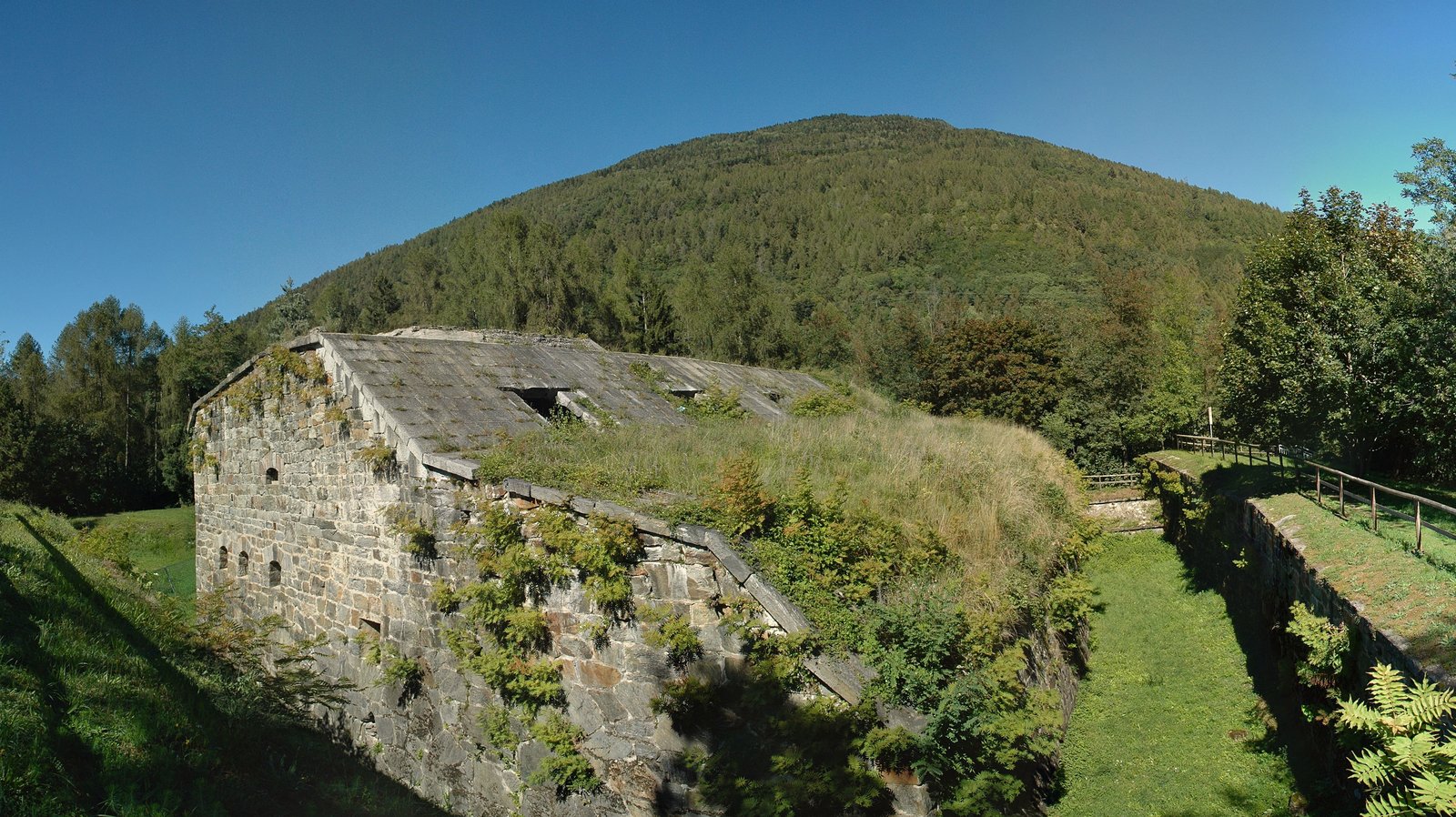
1914-1918 marks the most traumatic event in the recent history of the valley. Valsugana sits squarely on the front line: south of the Brenta the Lagorai becomes an Austro-Hungarian salient, to the north the Brenta valley is the possible Italian route of penetration towards Trento. From 1908 onwards the Austro-Hungarian army had built on the heights around Levico and Pergine a system of permanent forts: Forte Colle delle Benne above Levico, Forte Tenna on the slopes facing Lake Levico, Forte Cima Vezzena (which the soldiers called “the eye of the plateau”), and Forte Busa Verle. The Austrian Strafexpedition of 1916 made them grimly famous as the bridgehead for the offensive on the Italian front.
During the conflict the lower valley is evacuated: the populations of Borgo, Strigno, Roncegno and Grigno are moved to Bohemia and Moravia, into the so-called “refugee camps”, from which they will only return in 1918-1919 to villages that are often destroyed or seriously damaged. The material losses are enormous: much of Borgo Valsugana is razed by the bombardments, and dozens of historic buildings disappear for good. The post-war reconstruction, financed by the “Options” of the annexed province, runs across the whole of the 1920s.
The history of Valsugana from the post-war years to today
Between the two wars the valley is Italian to all intents and purposes, even if the frontier with German-speaking Trentino remains felt. Fascism Italianises the surviving place names and invests in minor public works. The post-war period reshapes the economy: subsistence farming declines, the alpine pastures empty, and part of the population emigrates to the northern industrial triangle or to Germany and Switzerland.
The turning point comes in the 1970s and 1980s with the provincial autonomy of Trento and a systematic investment in tourism. The Levico spa is relaunched, the network of campsites on Lake Caldonazzo is structured, the project of the cycle path gets under way, and the alpine pastures are reframed as a gastronomic destination. In the 2000s the network of the two lakes and the cycle path become the two main promotional pillars.
The forts as heritage
Over the last two decades the Austro-Hungarian forts have been progressively recovered and turned into sites of public memory. Forte Colle delle Benne is now open to visitors and hosts cultural events and a restaurant; Forte Tenna is under restoration; Forte Busa Verle and Forte Vezzena are part of the “Sentiero della Pace” circuit that runs the whole of the former Trentino front line. These are routes that can be built into a summer holiday as themed historical hikes, particularly meaningful around 4 November and through the weeks of commemoration.
An Italian frontier valley
The identity of Valsugana is still marked by its historic condition as a threshold. Italian in language, Austrian in recent administrative past, Venetian in commercial and family ties, Trentino in contemporary political organisation. This stratification, which a more homogeneous history has spared from other alpine valleys, is one of the reasons for its distinctive character. Walking the streets of Levico or Borgo you can still see the traces of all these overlaid periods: the nineteenth-century walls, the Italianised signage, the memories of the war, the post-war architecture.
- Levico Terme — the spa town that flourished under the Habsburgs.
- The Valsugana lakes — Caldonazzo and Levico in the valley’s geography.
- The cycle path — a pillar of contemporary tourism.
- Valsugana holidays — planning your stay.
- Back to the home page